
Redmond Previous Residents by Era
Previous residents research works as a dated address association, not a claim that every title party lived at the property. Begin with the current DIAL parcel frame, then work toward the period that matters. The best source changes with the date: a modern Recorder instrument can anchor title continuity, an annual tax roll can show a parcel association, and a printed directory or census can place an address in a dated household context. Keep these source types separate in the research log.
| Historical source | Years it covers | Where held | What it can support |
|---|---|---|---|
| DIAL parcel account and sales links | Current public account view | Deschutes County DIAL | Parcel/situs, map-tax lot, assessment context, and sale leads |
| Official Records | 1983 to present | Deschutes County Clerk's Digital Research Room | Instrument date, party role, recording number, and legal description |
| Historic deed indexes | 1871 to 1984 | County Records Research and historical research channels | Direct/indirect deed-index path, book/page, plats, and related series |
| Tax rolls | Historic series, date varies by record | County and State Archives holdings | Annual taxable-parcel association, description, value, and tax context |
| Central Oregon directories | About 1940 to 1990, plus scattered teens/twenties volumes | Library and historical collections | Printed name and address association when a specific volume is held |
| Federal census | Latest public census is 1950 in 2026 | National Archives and library research resources | Enumerated household and address context on that census date |
Start with DIAL for an address that exists now. Start with the Recorder and historical indexes when a transfer or old legal description is already known. Start with directories and census only after the parcel or timeframe is anchored. No reviewed source confirms a complete Redmond criss-cross directory sequence, so do not substitute an assumed reverse listing for the title and tax trail.
Start a Redmond Address Records Trail
Open Deschutes County Property Information, DIAL in Property Address (Situs) mode and search the current address with a stable full or partial form. Confirm the displayed situs, account number, and map/tax-lot before following a sales or documents lead. The account is the repeatable parcel anchor. Its ownership or mailing panel is a tax-record label, not evidence that the addressee occupied the situs.
DIAL's sales grid can show a sale date, seller, buyer, amount, recording instrument, and Recorder-research link. Treat that information as a lead to the instrument rather than the final answer. Record the access date beside the account number and map/tax-lot. If a directional street component is uncertain, preserve alternate candidates instead of silently choosing one.
The Digital Research Room entry screen requires acceptance of its disclaimer before the current recording system is used.
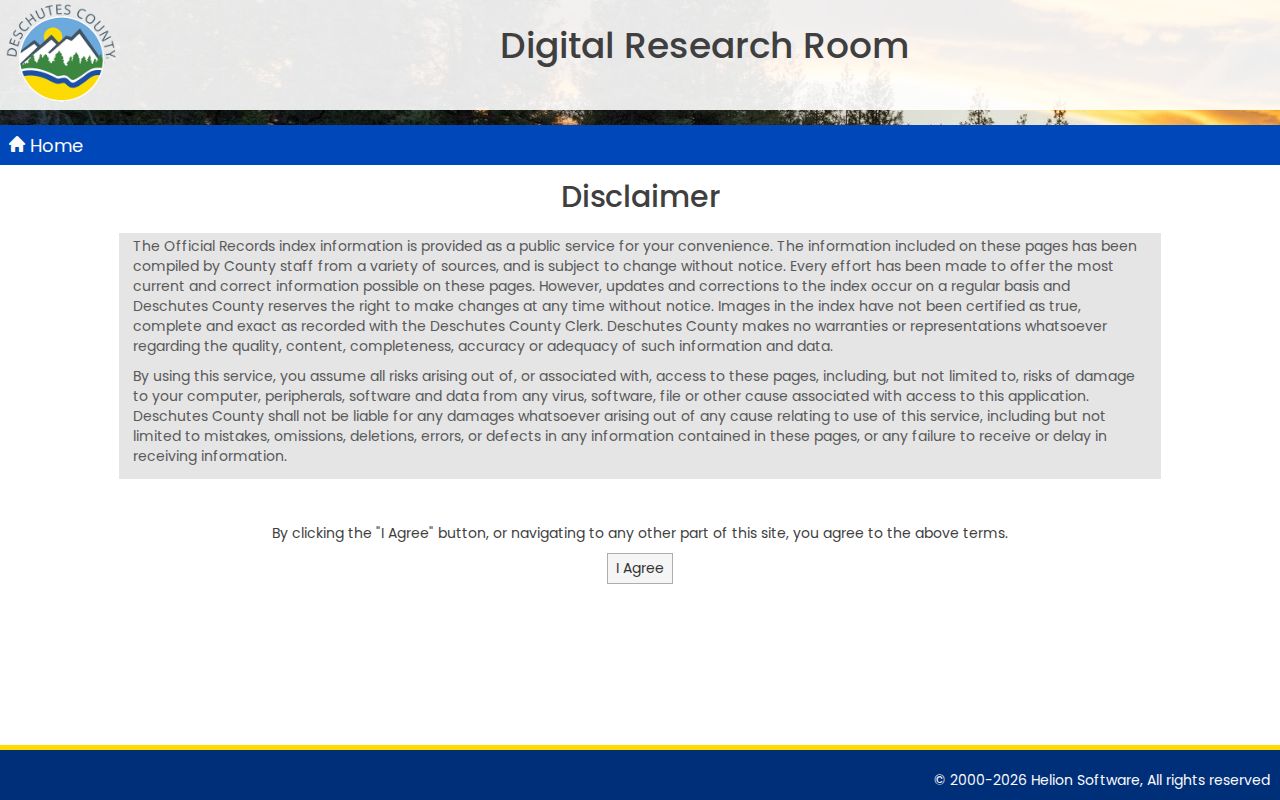
Acceptance opens the official-record research route, but the County still labels online images as non-certified.
Trace Redmond Title Records Backward
A title chain moves through recorded instruments, not through assumptions about where a party lived. After DIAL supplies the account and a sale lead, use the Deschutes County Recording service to find the matching instrument. The legal description and recording number are the continuity anchors. Party names alone are weak because a person may appear in more than one transaction or have a mailing address elsewhere.
- Save the DIAL account, map/tax-lot, displayed situs, search date, and any sales-tab recording lead.
- Find the Recorder entry and retain the recording number, document type, date, displayed party roles, and legal description.
- Compare the legal description or tax-lot with the parcel before treating the prior party as part of the same chain.
- Move to the earlier instrument through the grantor/grantee relationship, preserving book/page or index citations where shown.
- Continue through historic direct and indirect indexes when the chain reaches the older range, marking any replat, split, or unmatched description as unresolved.
- Grantor
- The party shown as transferring an interest in a recorded instrument.
- Grantee
- The party shown as receiving an interest in that instrument.
- Chain of title
- The dated sequence of recorded instruments connected by a matching parcel or legal description.
- Legal description
- The lot, block, plat, metes-and-bounds, or other land description that can identify land when a street address changes.
For a certified document, request a certified copy from the Clerk using the exact record reference. A screen image can support research notes but should not be represented as a certified record.
Redmond Address Records Across 1983
Deschutes County's record boundary is useful but not absolute. Online Official Records begin in 1983. The historic deed-index path reaches 1871 through 1984. When a transaction falls around the overlap, check both routes. This avoids a false conclusion that a record is missing merely because it appears in one system's coverage window but not the other.
The recording system uses date range, document type or subtype, party/index terms, and recording number. Preserve the exact displayed role. A direct or indirect party label is an index role, not a statement of family relationship or residence. If an online result has no image, the Clerk's copy route is the proper next step.
The County Recording page identifies the Digital Research Room and the historic-versus-current record coverage.
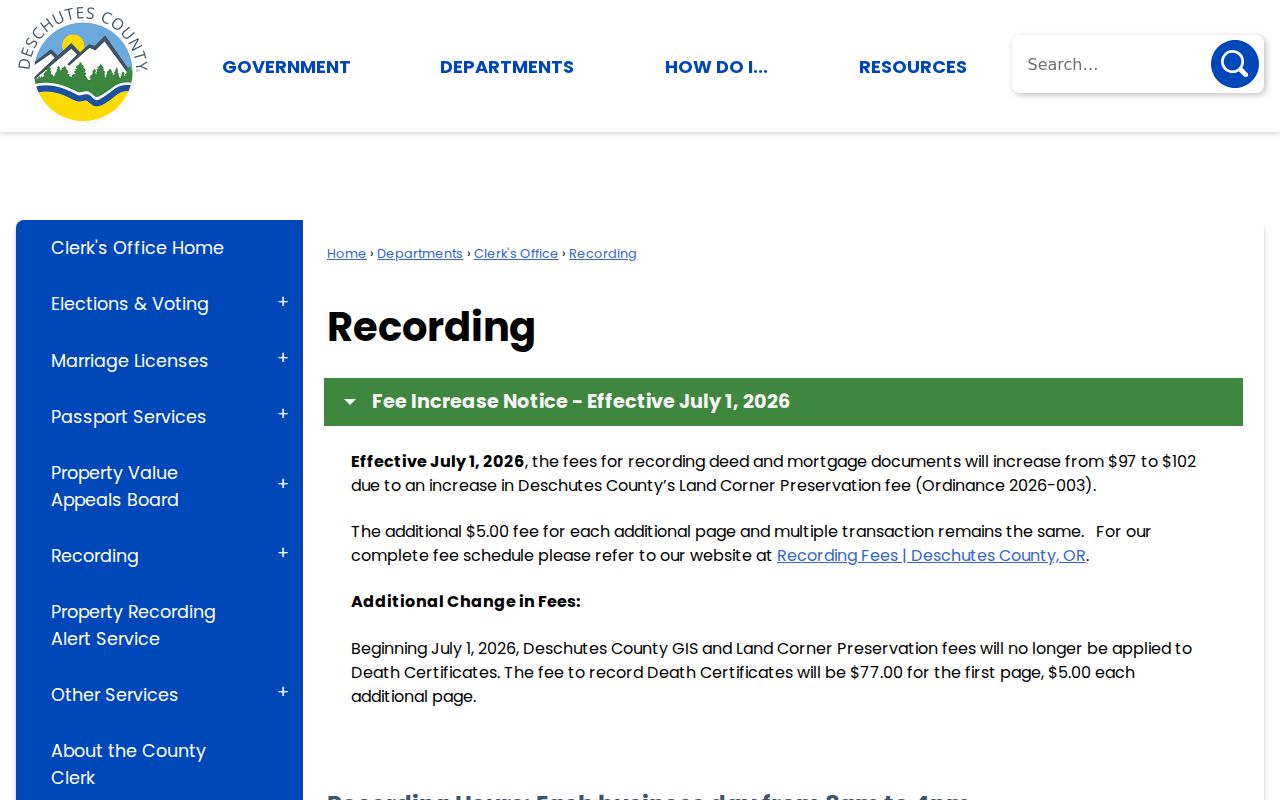
The coverage split tells a researcher which index path to try next; it does not tell when anyone moved into or out of the address.
Redmond Historic Address Records
The Deschutes County Records Research page supplies the historic-index route. Its menu identifies deed direct and indirect indexes, mortgage indexes, miscellaneous records, patents, and subdivision or metes-and-bounds grantor/grantee indexes. For older street research, plats before 1960 and metes-and-bounds indexes before 1960 can bridge a current parcel to an earlier legal description.
Use a historic index with a research log rather than memory. Save the spelling searched, year range, direct or indirect index, book/page, record number when present, document status, and the reason the legal description appears continuous. If the evidence points only to a similarly named road or parcel, label it as a lead. Do not collapse it into an address match.
The historical index menu identifies deeds, plats, patents, and direct/indirect index routes.
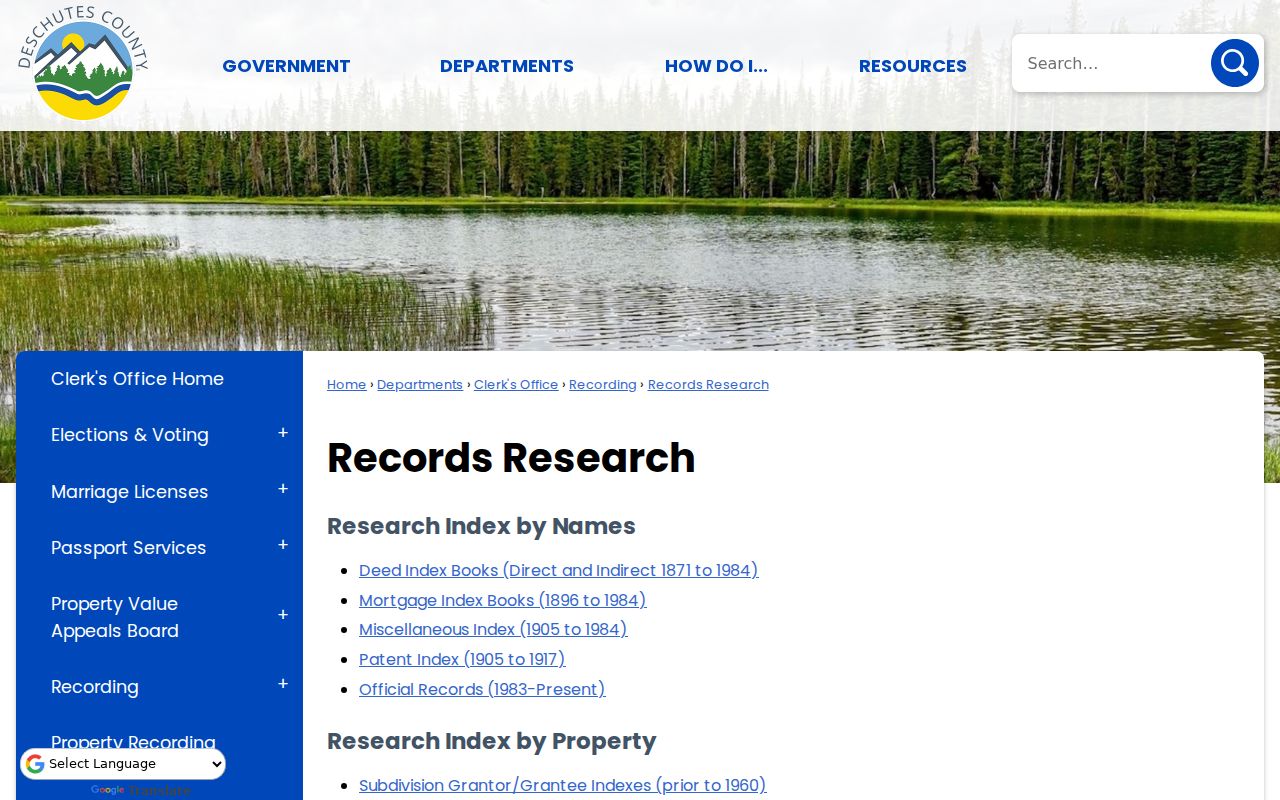
Those distinct series matter because an old legal description may be more reliable than a modern street label.
Redmond Past Residents and Tax Rolls
Tax rolls add a year-by-year parcel association that a single deed cannot provide. The State Archives inventory describes rolls with owner name, property description, values, assessment and equalization entries, taxes, and delinquency. That can show how a taxable parcel was labeled in a particular year. It cannot establish daily presence, move-in date, or a household composition.
Use the tax-roll year beside the exact parcel description. If it differs from the current description, compare plats, aerials, and recorded instruments before carrying the association forward. A parcel split, replat, or later subdivision can break a simple chain. The most accurate result may be a marked gap with the next repository or index to consult.
Note: Tax-roll owner labels support annual parcel association, not a finding that the named person lived there.
Redmond Address Records Need Maps
Historic Redmond records may use blocks, lots, plats, or metes-and-bounds instead of a present address. The original townsite was laid out in 1905 and incorporated in 1910 around a cardinal-direction grid. Later growth added blocks and subdivisions. A past resident search should therefore preserve the source's original address form and use recorded plats or map material to test any conversion to a modern site.
Use the City maps and property-information page for present municipal context and DIAL for the county parcel. Neither map view is a survey. Near the urban edge, the postal city, City boundary, and county parcel setting can diverge. The record custodian should follow the jurisdiction shown by the appropriate official layer.
Redmond Past Resident Records by Date
Title does not establish a household. To explore who lived here before, use independent dated sources. The Deschutes County Historical Society describes Central Oregon city directories for Redmond, Bend, and Prineville as about 1940 through 1990, with scattered teen and twenties directories. A specific volume can print a name, address, telephone number, and profession where shown. It is not evidence that every year is held or that a printed person remained there for the full year.
Use the historical collections as a source layer, not as a shortcut around parcel research. The verified holdings, access limits, and citation details are collected on the Redmond city directory page. The 1950 census is the latest federal decennial census open to the public in 2026. It provides household and address context on its enumeration date, while later census returns remain within the 72-year restriction period.
- Choose a directory year near the independently known event or parcel transition.
- Record the exact printed name, address, listing type, year, publisher, and page, including surname variants and initials searched.
- Pair that year with a tax-roll, deed, census, newspaper, probate, or archive record that has its own date and source citation.
- Describe the result as a dated address association and leave conflicting names or gaps unresolved.
Probate can add estate or heir context, and a newspaper or cemetery record can be a lead, but neither should replace the dated parcel and directory evidence. Preserve the difference between what a document displays and what can be concluded.
History and privacy. Use Redmond historic-address research for family history, estate questions, and property history. Do not use old records to pursue, harass, or expose a living person, and never try to defeat address-confidentiality protections.