
Redmond Directory Holdings
The most specific verified Redmond directory lead is the Deschutes County Historical Society’s museum research guide. It describes Central Oregon collections for Bend, Redmond, and Prineville, with directories from about 1940 through 1990 and scattered earlier volumes from the teens and twenties. That description establishes a useful range, but not an unbroken set of Redmond editions. A date that matters to a family question should be requested and inspected before it is described as available. The table separates documented collection types from assumptions that the public material does not support.
| Collection route | Documented time range | Keeper or source | Access caution |
|---|---|---|---|
| Central Oregon directories, including Redmond | About 1940–1990 | Deschutes County Historical Society museum collections | Ask for the needed edition; annual coverage is not confirmed. |
| Earlier Central Oregon directory volumes | Scattered teens and twenties | Deschutes County Historical Society museum collections | Scattered means a particular year may be absent. |
| History and genealogy resources | No Redmond directory run published | Deschutes Public Library | Database and collection conditions vary by resource. |
| Redmond Spokesman research resource | Issue coverage not stated | Deschutes Public Library resources | Use a dated issue as a companion source, not a replacement directory. |
A printed directory can show individual or business addresses, telephone numbers, and professional descriptions where the volume printed them. It is a historical source, not proof of an annual sequence, a complete digitized run, or a present connection to an address.
Source access begins with the Deschutes Public Library history and genealogy resources.
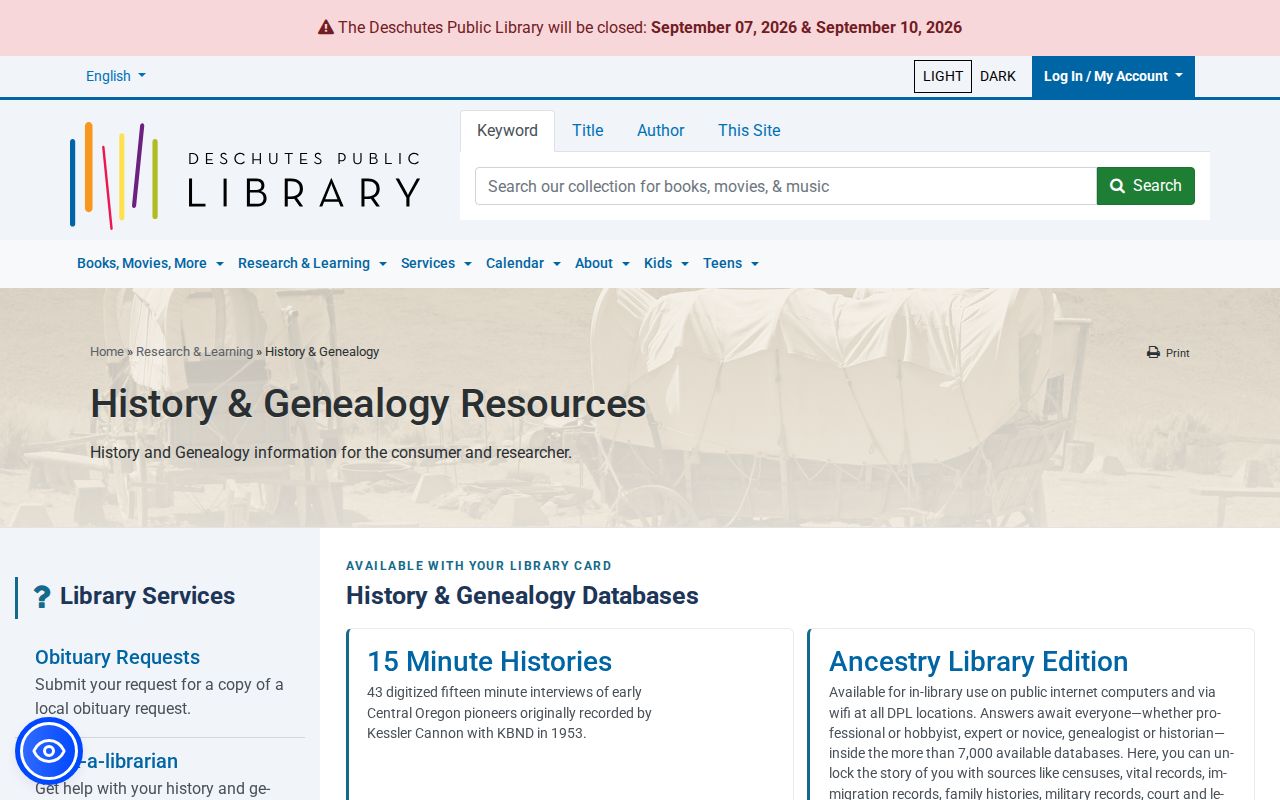
The library identifies local-history help and genealogy resources, including Ancestry Library Edition for in-library use. A database result remains a lead until its underlying record and access conditions are checked.
Redmond City Directory Coverage
Coverage language needs to stay exact. The museum guide uses an approximate 1940–1990 span and notes scattered older volumes. It does not publish a shelf-by-shelf year list, a publisher list for every Redmond volume, or a scan inventory. There is also no reviewed official source confirming a complete Redmond reverse-directory sequence. A directory search should therefore begin with a date request, then a note of what was actually consulted.
Record the printed edition year, publisher if printed, page, spelling, listing type, and any address form. Compare an entry with the nearest available edition only when the collection has that edition. A gap between two volumes is simply a gap. It cannot establish when a household arrived, left, or changed an address.
Note: A same-name result is stronger only when its date, address form, and a second record anchor also agree.
Redmond Directory Research at the Library
Deschutes Public Library is the practical public starting point for dated local material. Its research listings include the Redmond Spokesman collection and MyHeritage Library Edition, while the history page describes genealogy and local-history assistance. These routes can help locate a newspaper issue, map, directory citation, or family-history lead. They do not convert contributed material or a search result into an official identity record.
The library notes an important availability break: after 2014, the University of Oregon stopped microfilming the Bend Bulletin and Redmond Spokesman. The title may remain a useful research path, but a name or address search should identify the repository, issue date, page, and headline before it is used as evidence.
The library’s all-resources listing is the source for those local research routes.
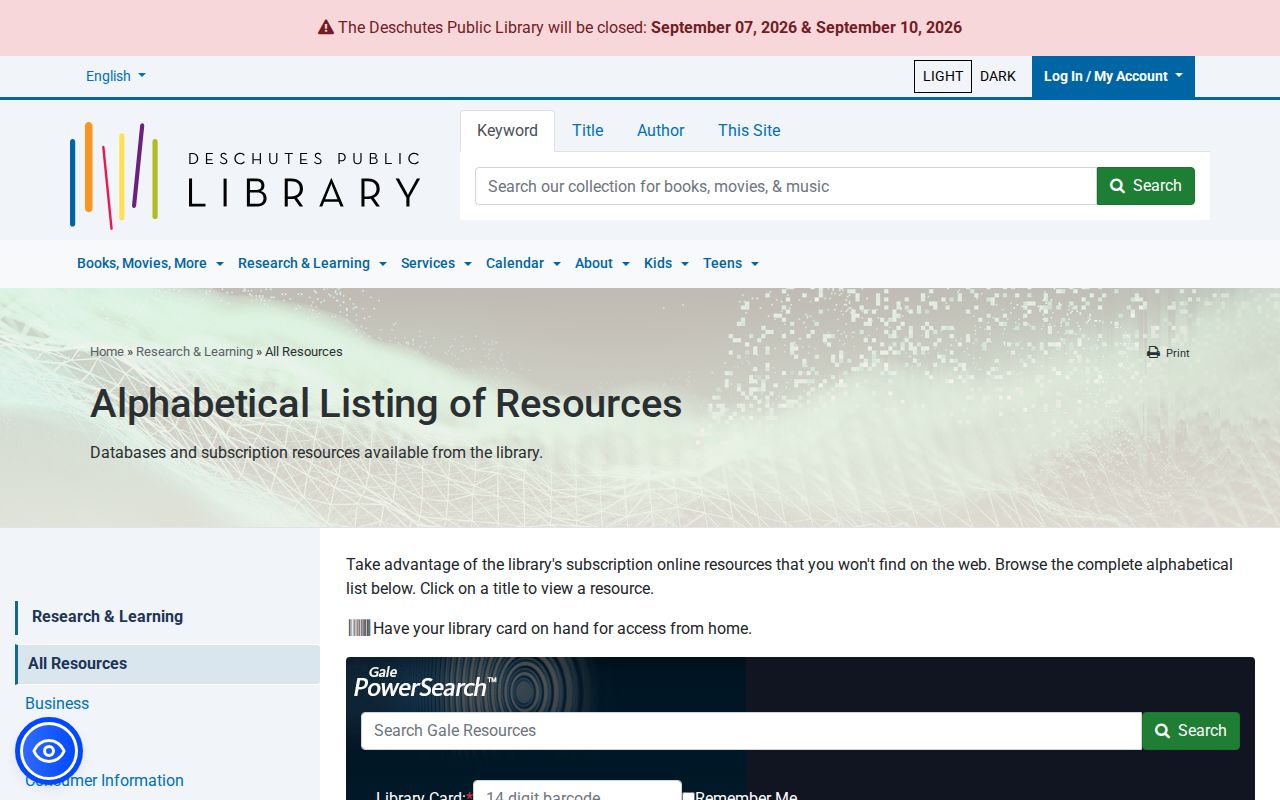
MyHeritage and in-library Ancestry access are collection tools, not a promise that every Redmond directory or newspaper issue is available remotely. Preserve the original volume or issue citation when a result is found.
Read a Redmond City Directory Entry
A printed Redmond entry should be transcribed as printed before it is interpreted. The verified collection description supports names, individual or business addresses, telephone numbers, and professional descriptions where printed. Different editions can arrange those fields differently. A blank field does not establish that the fact was absent from a person’s life; it only records that the inspected volume did not print it.
| Printed name | Copy initials, spelling, and any distinction between a personal and business listing. |
|---|---|
| Address | Preserve the full street form, direction, and whether the entry identifies an individual or business address. |
| Telephone number | Record it only when the inspected edition shows it, and keep the directory year beside it. |
| Professional description | Transcribe the wording when printed; do not add a role from another source. |
| Edition citation | Keep year, publisher if shown, page, and collection or repository. |
Some directory formats use terms that need careful limits.
- Criss-cross directory
- An address-order directory section, when a volume contains one. No complete Redmond criss-cross sequence was confirmed in the reviewed sources.
- Householder index
- A name-arranged entry section that may identify a household contact. Its exact format must be read in the edition at hand.
- Abbreviation key
- The volume’s own explanation of shortened terms or symbols. Photograph or note it before interpreting unfamiliar marks.
Redmond Archive Records Beside Directories
The Oregon State Archives inventory for Deschutes County supplies record classes that can test a directory clue. Historic tax rolls can connect a name to a taxable parcel in a stated year. Deed books and indexes preserve parties, dates, legal descriptions, and volume or page references. Probate files can identify a decedent, representative, or heir relationship as the record describes it. Historic election registers are another dated location lead, not evidence of present registration.
Each source answers a different question. A tax-roll owner label is not an occupancy finding. A deed party is not automatically a resident at the property. When a printed directory and a tax roll independently place the same carefully identified person and address in the same period, retain both citations instead of merging them into a single unsupported conclusion.
The Oregon Archives Deschutes County inventory identifies these historical record categories.
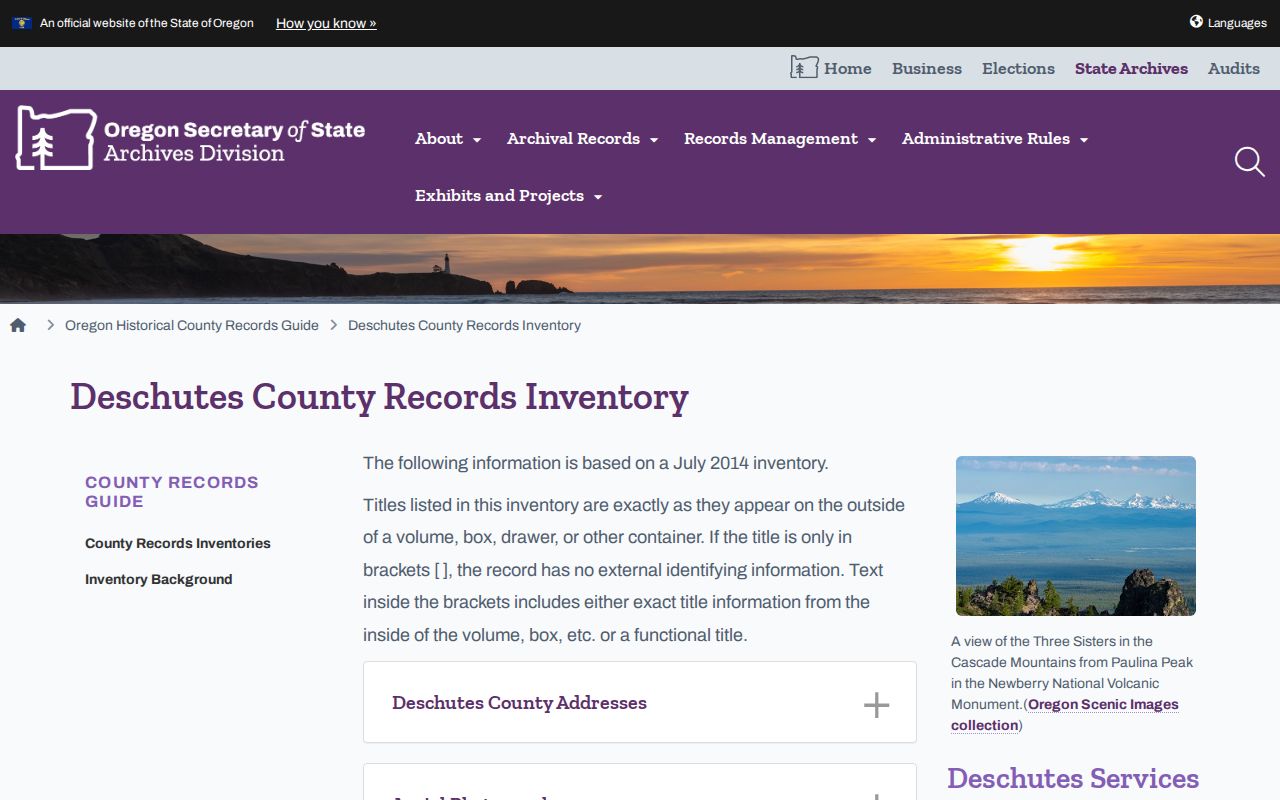
Archive descriptions point to source types and access routes. The item itself, its date range, and its displayed fields determine what can be said about a Redmond address.
Redmond Directory Addresses and the Townsite Grid
Redmond’s townsite was laid out in 1905 and the city incorporated in July 1910. The original layout used a cardinal-direction grid, which helps explain why NE, NW, SE, and SW components matter when a printed directory address is compared with a modern map. Older sources can instead refer to a block, lot, plat, or metes-and-bounds description. Those are different address systems, not automatic errors.
| 1905 | Official historic-resource documentation describes the Redmond townsite layout. |
|---|---|
| July 1910 | Redmond incorporated, according to the same historic-resource documentation. |
| About 1940–1990 | The Historical Society guide describes Central Oregon directory holdings in this approximate span, without proving annual Redmond coverage. |
| After 2014 | The University of Oregon stopped microfilming the Bend Bulletin and Redmond Spokesman, a newspaper-availability caveat. |
By 1928, 112 blocks had been added to the original townsite, followed by roughly 60 more postwar blocks. That history gives an address clue local meaning, but it does not prove that a current parcel had the same boundaries or form in an earlier decade. Plats, maps, and dated county records supply the bridge between eras.
Redmond Directories and the 1950 Census
Federal census schedules offer a separate household snapshot that can sit beside a dated Redmond directory citation. The National Archives states that the 1950 census is the latest public federal decennial census in 2026; later schedules remain within the 72-year restriction period. A census schedule may provide household composition, age, birthplace, and address context at its census date, but spelling and reported ages can vary.
Use a directory entry to frame a time period, then compare it with the census only where name, address, and date make the match plausible. The census is not a correction sheet for a directory, and a directory does not correct a census. A clear research note preserves both versions and explains any unresolved difference.
The National Archives census research overview explains the release framework.
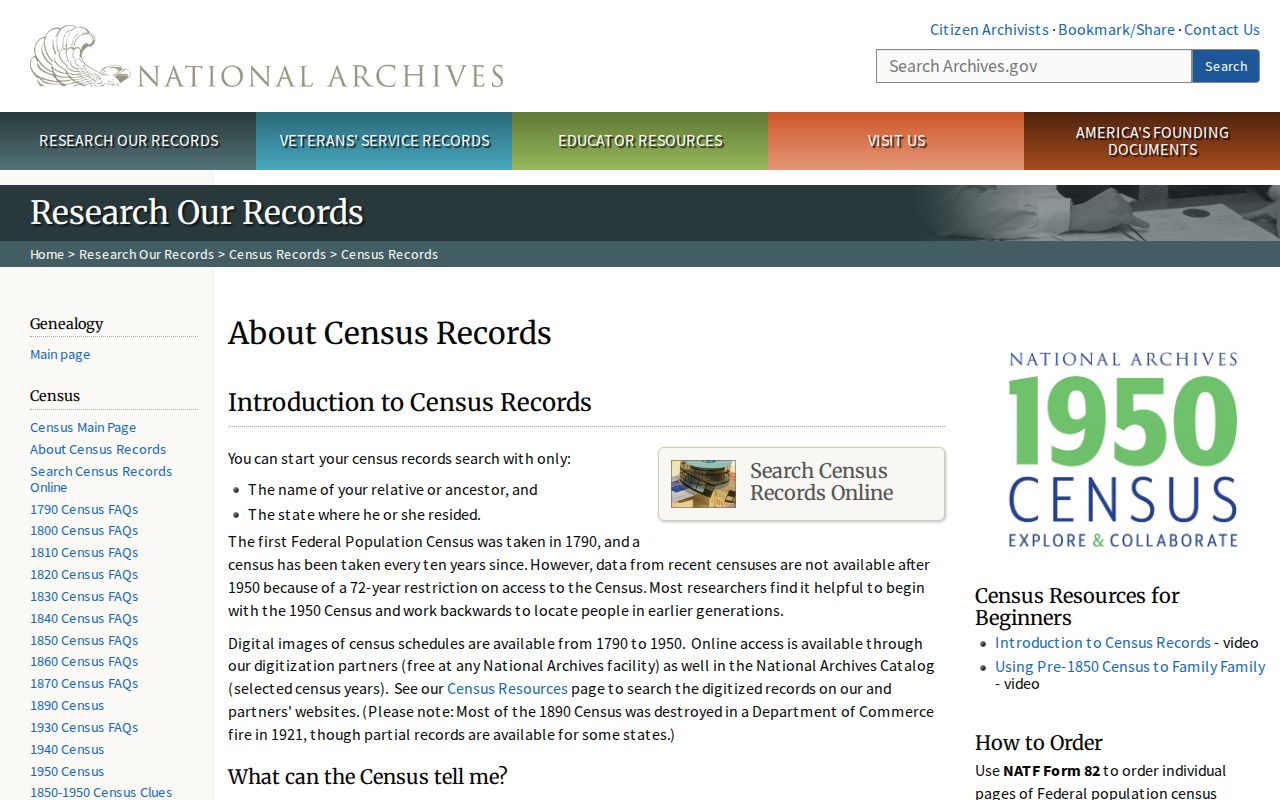
Census information is a date-bound household record. It becomes stronger when its address context is paired with an independently cited Redmond directory or county record.
Redmond Directory Context Sources
The Deschutes Public Library, Deschutes County Historical Museum, and Greater Redmond Historical Society form a useful local-history network. Library tools can locate research paths, museum collections can supply directories, maps, photographs, and family or subject files, and Redmond-oriented history materials can add context. A photograph caption, family file, or newspaper clipping should retain its source note and should be checked against dated archival or county material before it supports a precise statement.
For a newspaper clue, preserve the publication, issue date, page, and headline. For a map or photograph, preserve the collection title and date or circa date. These habits keep local color separate from the evidence needed to identify a person or reconstruct a historical address.
Note: A community-history source can guide the next search, but a dated record remains necessary for a specific address conclusion.
Tracing a Redmond Directory Household
A household trail starts with the edition closest to a known event, not with a guess that a volume was issued every year. Record the printed name, address, phone number if shown, professional description if shown, year, publisher, page, and listing type. Then seek an independent record from the same period. This method supports family-history and heir research while keeping the limits of each record visible.
- Request or locate the Redmond directory edition nearest the independently dated event, then search surname variants and initials.
- Transcribe the entry exactly and save its full edition and page citation.
- Check the closest available earlier or later volume only if the collection actually holds it, noting a missing year as a gap.
- Compare the address transition with a tax roll, deed index, census schedule, or contemporary newspaper item from the relevant period.
- Mark the result confirmed, probable, or unresolved according to whether name form, street, date range, and a second anchor agree.
Disappearance from a printed Redmond volume can reflect a move, a changed listing practice, a missing volume, or another untested cause. It does not establish a life event by itself. Once an historic address is well dated, the Redmond street directory provides the separate modern parcel-and-address research route.